
Home » Weah Fights Racism Globally: Leading FIFA’s Players’ Voice Panel
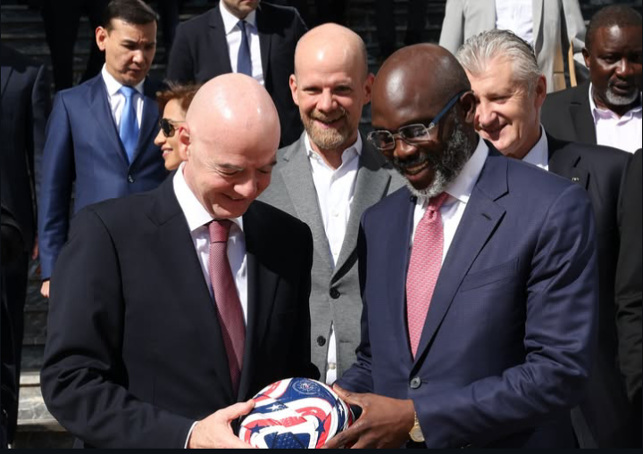
George Weah fights racism globally with a conviction that feels both personal and urgent. After decades on and off the pitch, Weah has seen every side of football’s beauty and its darker edges. Now, as the newly appointed captain of FIFA’s Players’ Voice Panel, he’s bringing his influence back to the global stage-not to score goals, but to help end discrimination across the sport he helped define.
Racism has lingered in football far too long. Fans have seen players targeted online, abused in stadiums, and forced to take stands no one should have to. For him, this isn’t theory. It’s lived experience. The former Ballon d’Or winner once faced chants and gestures that no player should hear, even in victory. That pain fuels his mission today.
In his own words, racism is a “disease.” And he’s determined to use his platform to help cure it. This new initiative under FIFA’s banner gives him both the reach and authority to make change happen.
The Players’ Voice Panel is one of FIFA’s most ambitious steps yet. They are a 16-member team of former male and female players globally. One shared goal of theirs is very clear: oppose racism in football and provide players with the opportunity to be heard directly in the development of the anti-discrimination policy.
The group includes names: Mercy Akide from Nigeria, Iván Córdoba from Colombia, Khalilou Fadiga from Senegal, Jessica Houara from France, Maia Jackman from New Zealand, Lotta Schelin from Sweden, and Mikael Silvestre from France, just to mention a few. In total, they are a combination of 14 football associations and six confederations.
Weah’s leadership adds gravitas. He knows what it means to represent both a country and a cause. In Rabat, during the panel’s first in-person meeting, he made it clear that this wasn’t just another committee. “As a former footballer and former leader of Liberia, my voice is critical because I played the game; I experienced racism during my time,” he said. “I thought I would be one of the players in a position to say, ‘No’ to racism.”
Weah’s rise resembles a screenplay, only it’s his actual life. He went from the dirt roads of Monrovia to the bright lights of Europe, making a career out of his talent and grit. He became one of the most deadly forwards on the planet at AS Monaco, Paris Saint-Germain, and AC Milan. He was the first and only African player to be awarded the Ballon d’Or in 1995.
However, his name will be remembered beyond the awards for being closely associated with the concept of representation. With every game he played, he was the embodiment of a continent’s dreams. Unfortunately, he had to endure racism, and this experience influenced his way of thinking. So, when he became the president of Liberia, he brought that viewpoint with him into politics.
At present, he is using the same resolve to bring back the good times in football. He’s not playing for goals anymore. He’s playing for humanity.
The panel’s global nature is one of its biggest strengths. Every confederation faces different challenges. Europe deals with organized fan groups that sometimes cross the line. Africa and Asia often confront institutional racism or lack of resources. Latin America and North America grapple with unique cultural divides. The Oceania region, on the other hand, concentrates on inclusion and access.
Weah’s way of leading values this diversity. The panel, instead of deciding universally applicable solutions, intends to change. Representatives from every continent will bring different tactics that are effective in their local areas, e.g. from supporter education programs in Senegal to online campaigns in Sweden. The panel thus becomes more vibrant and inclusive through this mutual exchange of ideas.
No movement is free from obstacles. The Players’ Voice Panel will face practical and political hurdles. Some federations may resist scrutiny. Others may lack funding or data infrastructure. The digital age adds another layer-how do you fight hate speech that moves faster than regulations?
Weah knows this. His time as Liberia’s president taught him that idealism needs patience and persistence. He’s realistic but hopeful. “We won’t fix racism overnight,” he said during the workshop, “but we can make sure future players don’t experience what we did.”
That realism gives this campaign credibility. Fans aren’t looking for perfection-they’re looking for proof that change is possible.
One of the characteristics, besides being the most popular sport, that football has, is that it is a cultural force. Billions watch it, millions play it, and thousands make a living through it. So, when such a powerful ecosystem takes a moral stance, it can change the mindsets way beyond the field.
Through this panel and others, FIFA’s engagement is a strong signal that equality is a non-negotiable issue. By putting players at the center, the entity realizes that those most impacted by racism should be the ones fighting it.
Weah’s power and charisma are able to connect the different worlds, one as a sportsman, a leader, a pioneer for Africa, and a global advocate.
George Weah fights racism globally not for recognition, but for redemption-the kind that transforms football from within. Leaning on a new style, his guiding hand of the FIFA Players’ Voice Panel is essentially the leading social change he is reminding us that talent can open doors, but it is bravery that keeps them open for other people.
The panel’s work is a long journey of several years, but it has only really achieved a crucial thing: it has stirred up the energy. Former players from all over the world are therefore, with him leading the way, turning their empathy into action. That’s how football gets changed- not by issuing catchy phrases, but by people who happen to be there and care enough to take the lead.
It is a signal to the fans, players, and clubs to come on board the effort. The battle against racism is the responsibility of all those who are fans of the game. And as George Weah often says, only as a team can we win.